I'm positive that we'll be able to implement these alterations to our shoot so that the post-production/editing stage is made easier.
Group 3 - Digipak

Our Digipack, top left - back, top right - front, bottom left - inside panel, bottom right - inside panel (CD)
 This is a link to our website, click the image above to enter our site
Showing posts with label AS Research and planning. Show all posts
Showing posts with label AS Research and planning. Show all posts
Saturday, 14 February 2015
R+P Post 20:Reflections so far/looking ahead
Through the pre-production stage, we've encountered a lot of problems that we didn't initially think about before going on our shoots; for example, lighting issues in the corridor where we can only shoot with the camera facing side otherwise the light gets messed up on the other side and the sound of the wheels on the dolly of the tripod being picked up by the camera. However thankfully with all the rehearsals we've had with actors, test shoots etc. we've been able to have time to encounter these problems and think of solutions to fixing them before the real shoot.

R+P Post 19:Our rough cut

 We compiled all the footage from our test shoot into a rough edit in the format of how we made our animatic so we it's easier for us to visualize the practicalities of how we'd shoot and edit our main shoot. From the rough cut we learnt a lot about things we'd need to improve for our opening sequence and in filming for the main shoot. Issues such as timing/framing of shots, choreography/movement of actors, positioning of titles in relation to the framing of shots came up. Directors also gain from making rough cuts because it helps them figure out any shots that need to be cut off from their film sequence, shortened/lengthened or reordered.
We therefore compiled a snagging list which we'd implement the changes we decided and suggestion on alterations from teachers into our next shoot. On the left is a picture of the snagging list(s) we made.

Friday, 13 February 2015
R+P Post 18: Our test shoot
In preparation for our test shoot we have to...
make a shoot board- because we have two test shoots on separate days, since we have two different locations and it's not possible to get permission to shoot at Latymer on a weekend (so instead have to shoot on a weekday), we have to make two separate shoot boards for the school (weekday) shoot and the routine (weekend) shoot.
sign a shoot organisation form- shown in the picture below is what we created so that everybody is clear on the logistics of the shoot& who in our group would be transporting kit (e.g. camera and tripod) to the location (Amber had that role), what actors are needed and what days we'll be shooting and so on.
Rehearsal days- to teach the actors their choreography since the corridor scene is going to be one long take. Therefore acting and timings of what actors do/say have to be precise. A video of one of the rehearsals that took place is directly below.
For the test shoot we're not going to finalize on costumes, props and full cast yet as we want to use this shoot to test lighting, camera movement and how our shots flow. Hence why we're also not using a full cast yet.
Below is the behind the scenes footage of our test shoot and one of our rehearsal days. Ela was ill the day of the school scene shoot so unfortunately couldn't attend. I was the director and Amber was in charge of the technical side (lighting, camera etc).
sign a shoot organisation form- shown in the picture below is what we created so that everybody is clear on the logistics of the shoot& who in our group would be transporting kit (e.g. camera and tripod) to the location (Amber had that role), what actors are needed and what days we'll be shooting and so on.
 |
| Shoot schedule |
For the test shoot we're not going to finalize on costumes, props and full cast yet as we want to use this shoot to test lighting, camera movement and how our shots flow. Hence why we're also not using a full cast yet.
Below is the behind the scenes footage of our test shoot and one of our rehearsal days. Ela was ill the day of the school scene shoot so unfortunately couldn't attend. I was the director and Amber was in charge of the technical side (lighting, camera etc).
R+P Post 17: Our planned costumes and props, hair and makeup
Group
|
Costumes
|
Props
|
Hair
|
Make-up
|
||

Arthur
|
Tshirt/hoodie
Jeans
Trainers
|
Map of
the school
|
NA
|
NA
|
||
 Emos Emos |
Fake piercings
Fake Tattoos
Dark
hair
Heavy
eye-makeup
Black
clothes
|
Fake
piercings and drawn tattoos
|
Heavy
and dark eye makeup, minimal on lips and face.
|
|||
Geeks/Nerds
 |
Glasses
Cardigan
and checked shirts
Flats/smart
shoes
|
Chessboard,
Science
Textbooks and Backpacks
|
Neat
and hair sprayed
|
NA
|
||
Chavs
 |
Adidas
trainers
Tracksuits
Hooped earrings
Slicked
back ponytail hair
Heavy
makeup
|
NA
|
Gelled
and slicked back into ponytails
|
|||
Athletic
 |
Tshirts
Jogging
bottoms
|
Basketball
(from Sports hall at school)
|
NA
|
NA
|
||

Hipsters
|
Chic trendy clothing
|
Handbags
|
Light on the eyes with bright lipstick
for girls
|


 |
| Amy (crying girl)-final chosen costume Makeup- smudged eyeliner Props- box of tissues |
Thursday, 12 February 2015
R+P Post 16: Casting
 |
| screenshot |
 |
| Cast list |
Because we want a large cast, maximum communication with them is needed. Therefore we are going to:
-create a Facebook group: (for updates on rehearsals and the types of costumes they'll be needed to wear)
-send out letters: (Instead of a call list like our teachers suggested we could use to notify our actors of times/dates they'd be needed) they're more personal and to demonstrate the high importance of our project so there is no misunderstanding on the level of commitment we need from them.
 |
| screenshot |
 |
| Letter draft |
Orange: Arthur
Green:Chavs
Red: Athletics
Blue: Nerds
Yellow: Hipsters
Grey: Crying girl
Black: Emos/Goths
R+P Post 15: Our planned filming location and set design


R+P Post 14: Production Schedule (shoot and edit)
Shoot schedule:
Actors rehearsal- Thursday 12th 4pm-5pm (Location 1, corridor scene)
Test shoot- Wednesday 4th 4pm-6:30pm (Location 1, corridor scene)
Saturday 7th 10am-3pm (Location 2 shoot, routine scene)
Saturday 7th 10am-3pm (Location 2 shoot, routine scene)
Actors rehearsal- Thursday 12th 4pm-5pm (Location 1, corridor scene)
Main shoot- Saturday 21st 9am-1pm (Location 2 shoot, routine scene)
Thursday 26th 4pm-6:30pm (Location 1, corridor scene)
Thursday 26th 4pm-6:30pm (Location 1, corridor scene)
 |
| Shoot organisation form (schedule) |
Edit schedule:
We didn't have a formal schedule for editing apart from our usual group meetings which we used. Aside from those meetings (refer to post "Development:how we intend to work as a group") we also came in individually during our free periods and sometimes if we could lunchtimes, since we all knew what we wanted the rough cut to look like through the animatic we had previously made together. Through this method it was faster in producing our rough cut and also demonstrates a benefit of the animatic.
Friday, 6 February 2015
R+P Post 13: Our Shoot-board
 It's essential we made a shoot-board for our shoots (whether a test shoot, main or back up one) in order for us to make the process of filming much more efficient (less time-wasting) and gave whoever is directing or filming at the time greater clarity on how things should be done during the shoot. The fact that it's all been compiled into one big spreadsheet makes it easier to read and less paperwork to carry around.
We decided to make two separate shoot-boards, because we are planning to shoot on two different days of the week (one weekday and one day out of the weekend) since the location of the school we were planning to use was not available on a weekend day.
.docx.png)
All the takes we're able to film during the shoot will be recorded in the "takes" section of the spreadsheet and the last section (identifying the good takes) will be filled in when looking back at our clips.
All the takes we're able to film during the shoot will be recorded in the "takes" section of the spreadsheet and the last section (identifying the good takes) will be filled in when looking back at our clips.
R+P Post 12: Animatic
Above is our finished Animatic, which is a preliminary version of a film produced by shooting successive sections of a storyboard and adding a soundtrack, but instead we decided to take pictures of each individual shot on our storyboard and edit them together on a sequence with drafts of our planned titles. This helped us visualize the type of shots we would do together with timing (combining both elements of the timeline and storyboard we created).
 |
| Animatic in the making |
We realized through the animatic that our sequence would have problems with:
-the 180 degree rule
-timing of titles
R+P Post 11: Storyboard
 We decided to make a storyboard, not only so we could visualize the layout of our opening sequence, but also for us to know how we will be shooting each specific shot. Hence why each shot is colour coded:
Yellow
|
CU
|
Green
|
MS
|
Pink
|
LS
|
The use of large sugar paper was essential since it's 3 people working over one storyboard so we needed space to be able to work on it simultaneously. Post it notes made it easy to move around when we decided to change the order of shots or made mistakes.
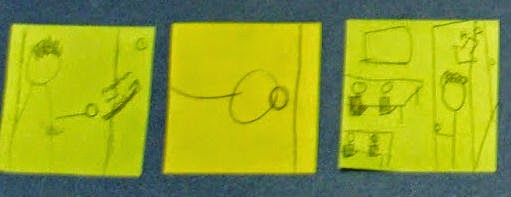 This mini sequence from our storyboard demonstrates the use of continuity as it has a match on action shot of the main characters hand on the door and then following that a master shot of the classroom he walks into.
 This mini sequence shows a shot-reverse-shot, another continuity technique we will use in editing.
 This sequence helps us visualize the split screen idea we want to implement during our editing stage where we combine up to 3 shots on screen for the audience to see simultaneously. This is because we want our routine part of the opening sequence to move fairly quicklu and not dominate the main part of our opening which will be the corridor scene.
Before we produced a storyboard we created a timeline so that we can get the timing of our shots before visualizing them. It was a very basic timeline with just a short description of each scene shown below where each piece of paper representing 30 seconds of the 2 minute sequence. Making a timeline made the production of a storyboard easier. Here is 30 seconds of our timeline that we made.

Thursday, 5 February 2015
R+P Post 10: Reflections so far/ looking ahead
We've done a lot of research into the genre and plot of our film and have a lot of references into how to edit/film our opening sequence, however the hard part now is sorting out the practicalities of shooting our opening sequence; for example, how many actors we'll need and how we will be able to handle them, costume etc. But I'm sure that as a group we'll be able to use our research and put it to use when making all those later decisions so that everything we do for our shoots can relate back to genre and audience.
R+P Post 9: Our script

.jpg)
From research, on the left hand side is an online script from Superbad (the draft of 2006-2007) which we used as inspiration for how we wrote our script.
Where speech is found is only to establish the fact to the audience that it's his first day at school (connoted through dialogue between him and his mum as he's waking up) and to establish characteristics of some cliques in school (eg. hipsters/emos/athletics).
We decided to have minimal speech during our opening since what's really carrying our opening sequence is music and expression/gestures of characters in the social cliques.
Where speech is found is only to establish the fact to the audience that it's his first day at school (connoted through dialogue between him and his mum as he's waking up) and to establish characteristics of some cliques in school (eg. hipsters/emos/athletics).
R+P Post 8: Our opening sequence idea
-Actors names in accordance with music credits and screenplay credits in a timed manner during the sequence
-Will be interacting with the objects on the screen when
-An easy to read font
SFX used:- School bell
- Alarm clock
-Door opening/shutting
-High school ambience (students talking)
 |
| Split screen idea from 127 hours we want to use |
-School corridor
-Kitchen
-Front door
-School entrance door
R+P Post 7: Our film's title and Plot outline
Title: New Guy (connotes clearly the narrative of the film)
Narrative: Our film's narrative is based on the themes of new school, new kid trying to get in with the "in"crowd and social cliques/stereotypes which are present in the (trailers of the) references below used to guide us in deciding our plot.
Synopsis: Arthur is a new kid at a new North London school and decides to try to climb the social ladder in order to fit in as one of the "cool" kids. (Levi Strauss binary opposites theory: Popular and unpopular)
Beginning:New kid Arthur enters a new North London School but immediately finds himself an outcast to the social hierarchy of the school. (Todorovs theory: equilibrium)
Middle: So he devises a plan to climb the social ladder and achieve what he believes his rightful place as one of the "cool" kids. He acquires genuine friends (who too are not considered popular but display the characteristics of true friends) who help him along the way.
He ends up getting too caught in the process, becoming more and more like the "cool" backstabbing, mean, self obsessed and superficial. (Todorovs theory: Unbalanced equilibrium)
End: Realizing this isn't actually what he wants or who he is he reverts back to where he was in the beginning: an outcast but with true friends and happy. (Todorovs theory: New equilibrium)
Wednesday, 21 January 2015
R+P Post 6: Our chosen genre and how we plan to connote this
Chosen genre: Teen, Coming of age
Sub genre: Comedy, Indie
How we plan to connote this:

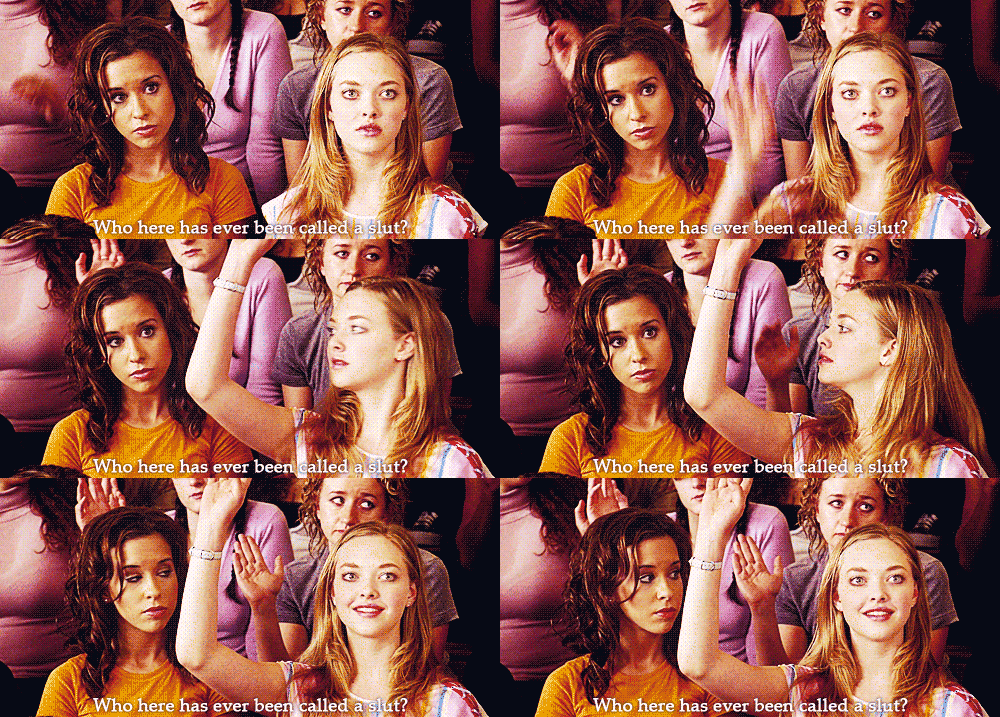
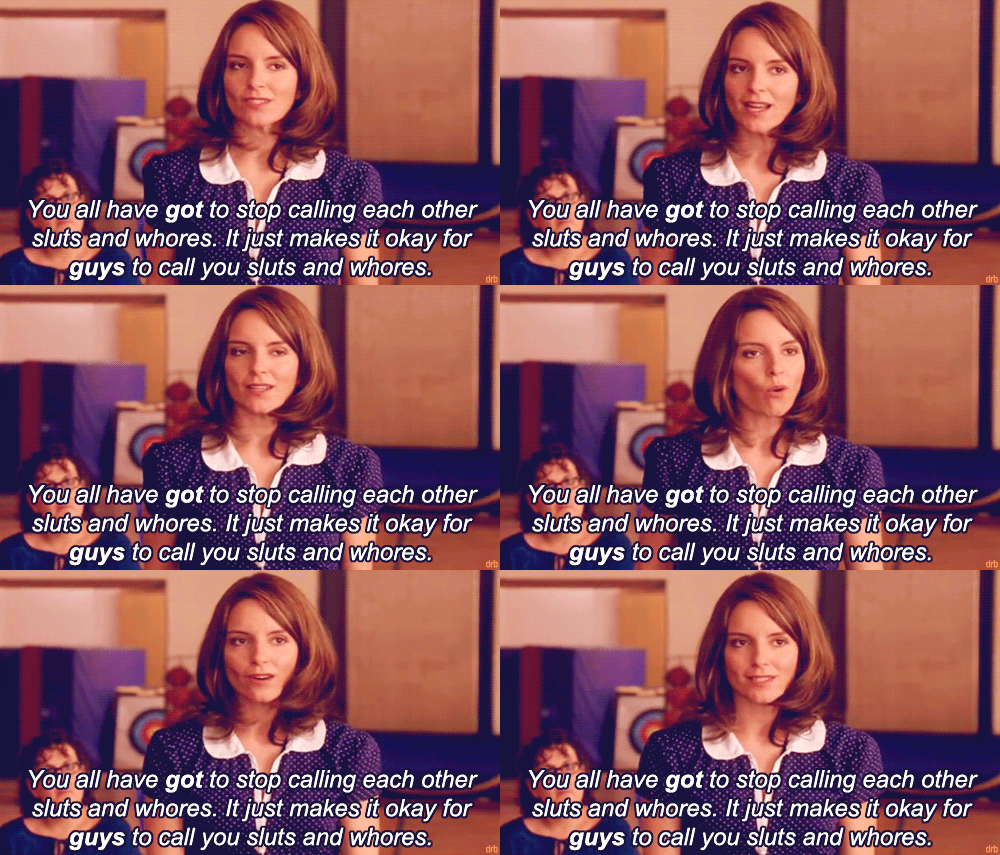
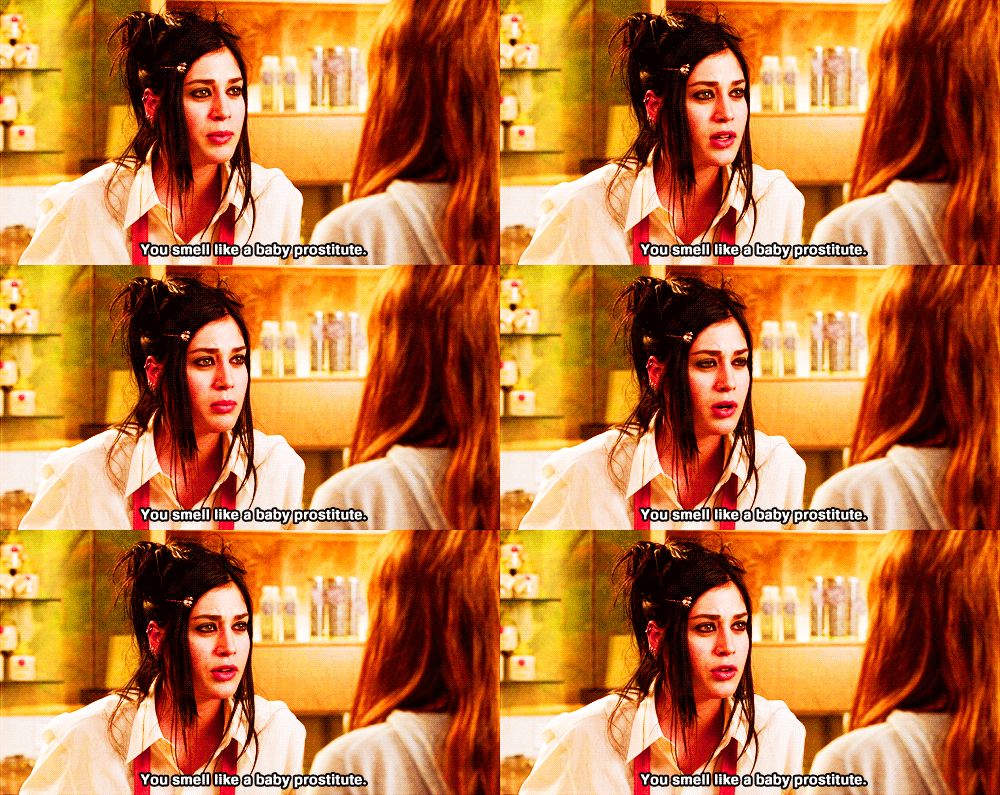
 When searched on Google "Funniest teen comedy movie", Mean girls came up as the second suggestion.Therefore most of the genre conventions we include will be inspired from this film, also mainly because it has a very similar plot to ours. On Rotten Tomatoes, it has been reviewed as "funnier and more smartly written than the average teen comedy", giving more impetus as to why we're using it as a guide.
Conventions of teen genre implemented:
 Cliques: "they are acknowledged greatly in Mean girls". Types of cliques consist of jocks/cheerleader, geeks/nerds, emos/goths, loners, stoner, artsy people, populars, people who aren't in a clique (usually the protagonist)
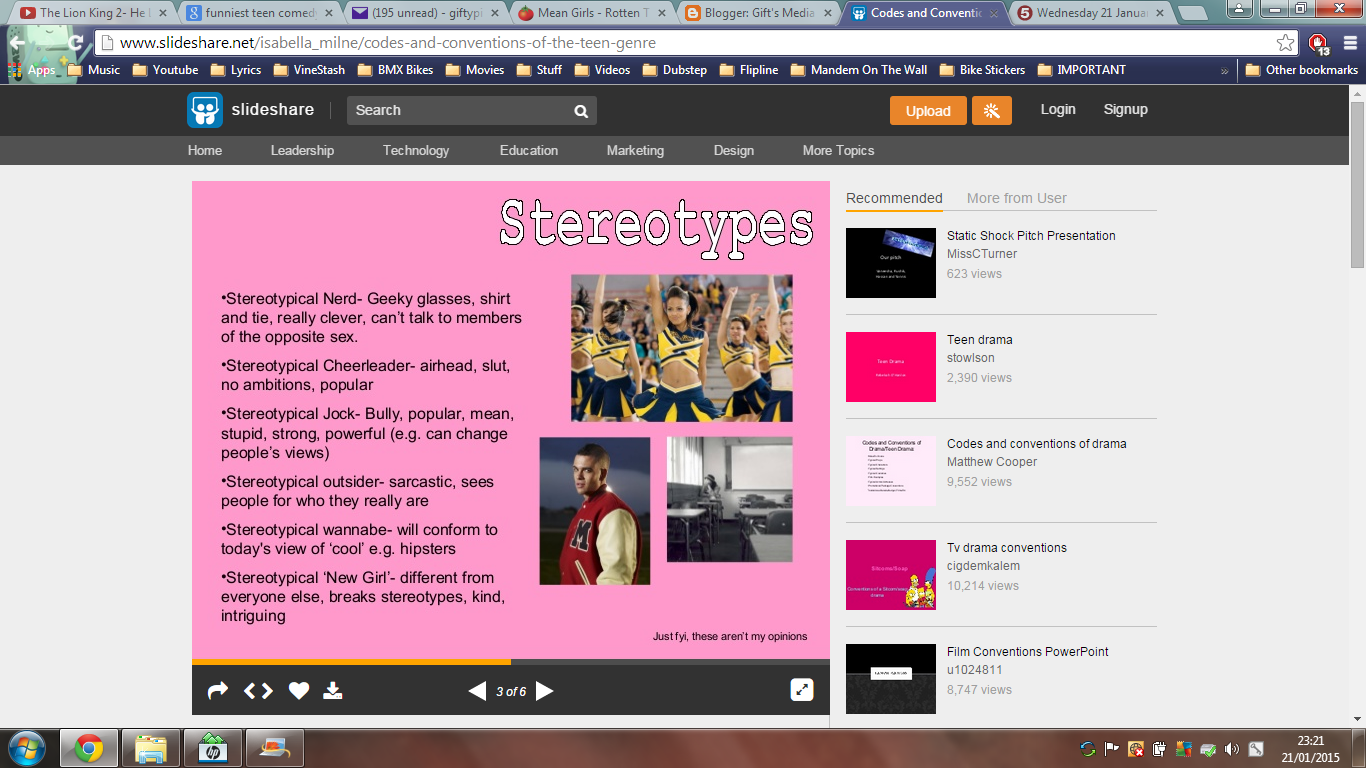 Settings: locker room (jocks/cheerleaders), dining room (where you sit defines your status), hall/corridor (where all the students congregate and are equalized), house of characters (for house parties/sleepovers/ where the family come together in the kitchen)
Teen issues: to conform/to not conform, peer pressure, hating life, outcast (definitely shown through the loneliness of the character as he walks down the hallway full of students in groups in our opening)
 .
.
Conventions of Comedy genre implemented:
The kind of humour used will be slapstick comedy, just not so vulgar and violent like in the Inbetweeners.
Technical code: a lot of handheld camera in the 'getting ready' part of our opening that follows our main character and point of view filming to film his perspective of the school and its students
Iconography: Bright colours across all the students outfits. Iconography for specific characters (e.g.the Goth of the school would wear all black, heavy eyeliner and have piercings and tattoos)
Character types: The main character would be a regular person who doesn't fit in with the usual system of the school, so the students in the school to him would seem wacky and weird. Making him also look socially awkward to them.
Setting: British High School and the main characters house
Sub genre: Comedy, Indie
How we plan to connote this:
When searched on Google "Funniest teen comedy movie", Mean girls came up as the second suggestion.Therefore most of the genre conventions we include will be inspired from this film, also mainly because it has a very similar plot to ours. On Rotten Tomatoes, it has been reviewed as "funnier and more smartly written than the average teen comedy", giving more impetus as to why we're using it as a guide.Conventions of teen genre implemented:
Cliques: "they are acknowledged greatly in Mean girls". Types of cliques consist of jocks/cheerleader, geeks/nerds, emos/goths, loners, stoner, artsy people, populars, people who aren't in a clique (usually the protagonist)Settings: locker room (jocks/cheerleaders), dining room (where you sit defines your status), hall/corridor (where all the students congregate and are equalized), house of characters (for house parties/sleepovers/ where the family come together in the kitchen)Teen issues: to conform/to not conform, peer pressure, hating life, outcast (definitely shown through the loneliness of the character as he walks down the hallway full of students in groups in our opening)
. Conventions of Comedy genre implemented:
The kind of humour used will be slapstick comedy, just not so vulgar and violent like in the Inbetweeners.
Technical code: a lot of handheld camera in the 'getting ready' part of our opening that follows our main character and point of view filming to film his perspective of the school and its students
Iconography: Bright colours across all the students outfits. Iconography for specific characters (e.g.the Goth of the school would wear all black, heavy eyeliner and have piercings and tattoos)
Character types: The main character would be a regular person who doesn't fit in with the usual system of the school, so the students in the school to him would seem wacky and weird. Making him also look socially awkward to them.
Setting: British High School and the main characters house
Monday, 19 January 2015
R+P Post 5: How we plan to attract/address our target audience
Our Target Audience: How we will attract them:
16-24 year olds - Familiar setting of school location
 - Relatable storyline: the popularity struggle that all teenagers go through in that type of school environment
- There are many races represented in the school, which would also represent a British audience as Britain is a multi-ethnic country.
British audience
 - Set in a British school with British accents, acts as a USP
because not many of these types of coming of age, teen comedy films are British.
-The script, because I read in a very interesting article up on British audiences saying "the British (and i say this as an american) are more literate and verbal and appreciate the emphasis on spoken language in the theatre in a way that Americans, a visually oriented people do not"
Comedy fans - The script
- the unbalanced framework of the school&nutty characters are in themselves unusual and therefore funny.
Also the fact that it's set in a school and involves the stereotypical kinds of teenage social groups, would appeal to even older age groups because many have gone through school and would find the plot of the film relatable as it brings them back to when they were younger. Like Superbad is reviewed to be "a film for any age group who are happy to share in its reminiscences of the past, and in particular of the teenage life", we also aim to attract older audiences with this quality in our film.
References: http://www.slideshare.net/JazBro11/how-did-you-attractaddress-your-audience-12763099
16-24 year olds - Familiar setting of school location
- There are many races represented in the school, which would also represent a British audience as Britain is a multi-ethnic country.
British audience
- Set in a British school with British accents, acts as a USP because not many of these types of coming of age, teen comedy films are British.
-The script, because I read in a very interesting article up on British audiences saying "the British (and i say this as an american) are more literate and verbal and appreciate the emphasis on spoken language in the theatre in a way that Americans, a visually oriented people do not"
Comedy fans - The script
- the unbalanced framework of the school&nutty characters are in themselves unusual and therefore funny.
Also the fact that it's set in a school and involves the stereotypical kinds of teenage social groups, would appeal to even older age groups because many have gone through school and would find the plot of the film relatable as it brings them back to when they were younger. Like Superbad is reviewed to be "a film for any age group who are happy to share in its reminiscences of the past, and in particular of the teenage life", we also aim to attract older audiences with this quality in our film.
References: http://www.slideshare.net/JazBro11/how-did-you-attractaddress-your-audience-12763099
Sunday, 18 January 2015
R+P Post 4: Representation of Social groups in our opening sequence
Since our film is a teen comedy and is set in a North London school, the social group we will be representing is British teenage boys and girls of relatively middle class.
- We decided to break the stereotype of school uniform in a British high school by having our cast all in non uniform, mainly because it would to difficult to organise for our large cast.
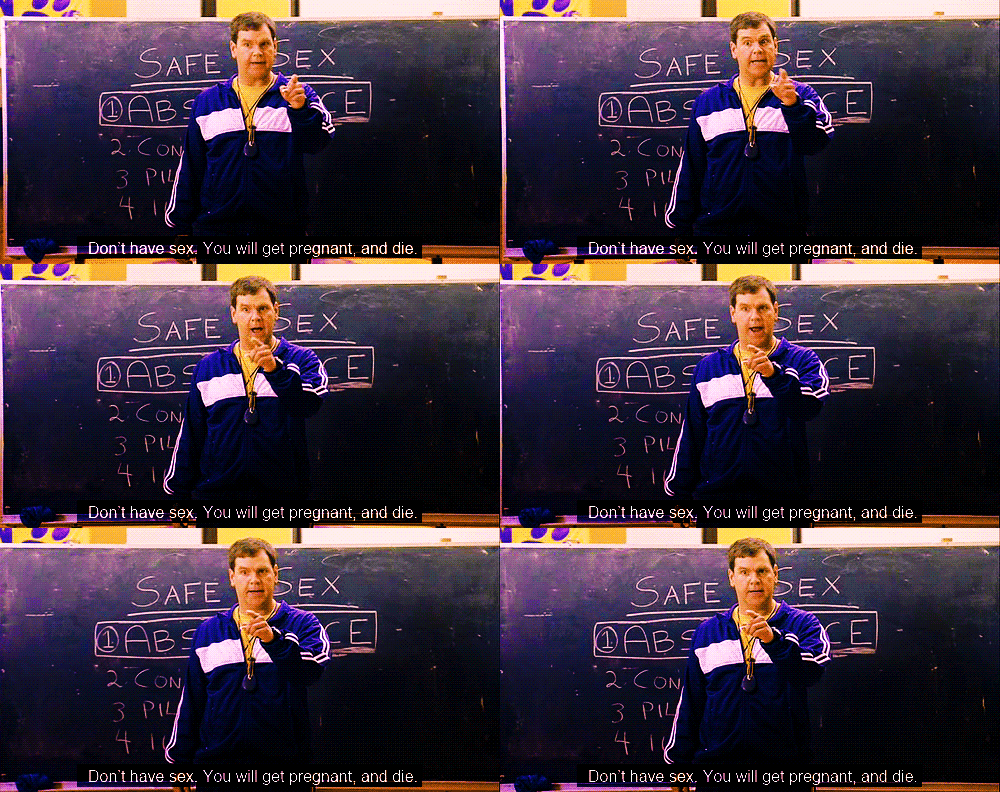
 - We're grouping our cast into the stereotypical teenage groups you'd see in high school in order to create the stereotypical 'cliquey' atmosphere you would find there (as exampled in the mean girls clip below); for example, the "chavs", the "nerds", the "populars" and the "druggies".
.gif)

 -Teenagers are portrayed in all teen/coming of age films as loud, busy socialising (either through parties, gossiping etc.), fighting (boys mainly), disrespectful to adults, sex crazed and everyone has their place in the hierarchy of high school. These stereotypes will be adhered to in the opening through the different groups mentioned above in our opening.
-The desire in most teens to fit in with the crowd and be accepted by the social elites, usually called "the popular crowd", from the films we've researched similar to the genre that we're doing (like Mean girls, 21 Jump street and Super bad) will be symbolized through the movement of our main character in the opening.
-We have decided to comply to the British accents shown in "The Inbetweeners" and "St Trinians" since the actors we will use will be British and have the accents already.
- We decided to break the stereotype of school uniform in a British high school by having our cast all in non uniform, mainly because it would to difficult to organise for our large cast.
.gif)


-The desire in most teens to fit in with the crowd and be accepted by the social elites, usually called "the popular crowd", from the films we've researched similar to the genre that we're doing (like Mean girls, 21 Jump street and Super bad) will be symbolized through the movement of our main character in the opening.
-We have decided to comply to the British accents shown in "The Inbetweeners" and "St Trinians" since the actors we will use will be British and have the accents already.
Subscribe to:
Posts (Atom)